You’ll face many challenges when writing a novel…
However, perhaps the most difficult challenge of all is finding—and then maintaining—your creative flow. After all, even when you do find your flow, you’ll often lose it the moment you hit a mental roadblock. Forget a character’s name? Need to research a location for your story? All of these hurdles can stop your writing in its tracks.
So, what can you do? Well, there’s no magical cure for writer’s block, but there is one simple trick that can help—using placeholders in your writing. In fact, by using placeholders you can not only nurture your creativity, but write your first draft faster along the way!
The Danger of Distractions
 Successfully writing a novel is all about staying focused and nurturing your creative flow—and, as a result, a lot of writers go to great lengths to eliminate distractions before they sit down to write. They outline their novels in detail, create the ideal writing space, and shut themselves away for some focused, distraction-free writing time.
However, in the process they forget the biggest distraction of all—themselves.
You see, often what distracts us while writing isn’t noise or nosy neighbors, but our own mental state. Writing a novel isn’t a singular task, and it requires us to equip a variety of mindsets along the way. You have the creative side for writing, as well as the more analytical side for outlining and editing, and plenty of others in between.
Unfortunately, sticking to one mindset isn’t always easy. You’ll be writing away, feeling the words flow from your fingertips, until suddenly you come across something you’re unsure of. Do you really want to name this character Sarah, or would Janice fit better? Sure enough, your creativity slams to a halt, and suddenly you’re knee deep in the analytical side of writing—often called your inner editor.
So, what should you do?
Well, rather than letting yourself lose your creative flow, there’s actually a simple tool you can use to maintain your momentum and keep your inner editor at bay—placeholders! Best of all, these placeholders can also help you write your first draft faster, since you won’t constantly be slamming on the breaks to obsess over your writing.
How to Use Placeholders to Write Faster
The Basic Idea Behind Placeholders:
First up, let me explain the basic principle of using placeholders. If you’re unfamiliar with what I mean when I say placeholder, these are simply keywords you use as stand-ins whenever you aren’t sure what to write.
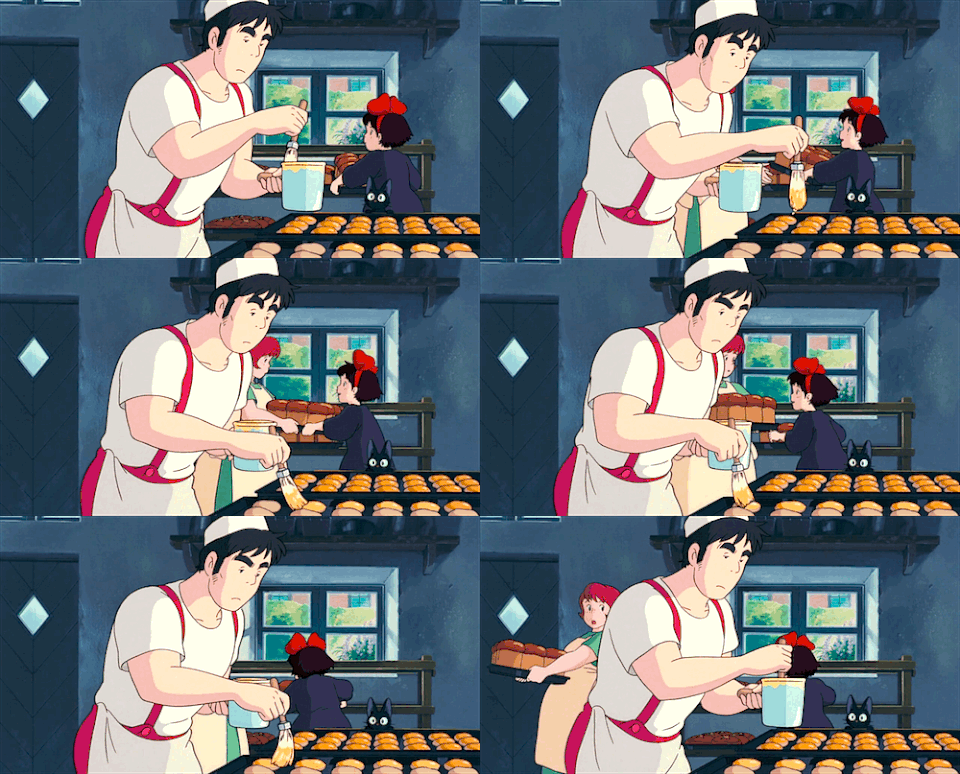
For example, say you create a new character that’s the baker at your protagonist’s local grocery store—but you aren’t sure what to call them. So, rather than grinding your writing to a halt to research potential names, you simply substitute their name with a placeholder. This could be anything from something silly like “Thing #1” to something literal like “Bakery Man.”
However, you aren’t limited to names here!
This same principle can apply to locations, magical spells, technology, and a lot more. Really, anything can benefit from a placeholder if it’ll help you maintain your writing flow. Are you struggling with a piece of prose? Then it’s placeholder time! What if you’re stuck on a whole scene? It’s placeholder time! While placeholders may be easiest to use with names and proper nouns, you can easily adapt them to work with any part of your story you’re stuck on.
Personally, I tend to struggle with dialog, so to maintain my momentum I simply write “TK” whenever I get stuck—these letters don’t have any meaning, but they’re easy to search later on, which we’ll talk about in a moment. Then, I’ll write a few notes on my thoughts in parentheses, before moving on with my draft.
The result looks something like this:
Maxwell sighed and reached out his hand. “Margaret, I don’t think we can win this fight.” TK (he admits he’s afraid of what the sheriff will do if he finds out they’re hiding the fugitive. She appeals to his sense of justice, but he’s uncertain. At some point they move to the porch.)
Taking Your Placeholders to the Next Level:
Of course, incorporating placeholders into your draft is all well and good, but there’s one more step you can use to make these placeholders even more useful.
All you need to do is create some kind of record.
To do this, you’ll simply keep a pad of paper or a blank document beside you and jot down any placeholders you use while writing your first draft. Write down what that placeholder is, along with a brief description of what it means, so you can reference it later. For instance, using the baker example from before, I would write: Thing #1, baker at the local grocery.
This serves two key purposes. For starters, it ensures you’re keeping your placeholders consistent—you don’t want your baker to be both Thing #1 and Dragonslayer98, after all. Plus, by the time you’re done writing your first draft, you’ll have a handy key for every placeholder you’ve used, making it that much easier to fill them in down the road.
Which brings us to our next topic…
What to Do With Placeholders in Later Drafts
Eventually, you’ll need to fill in your placeholders with their actual text, but searching through your manuscript page by page sounds like a pretty miserable job…
Fortunately, you don’t have to read every word in your novel to find your placeholders!
If you followed my tips in the previous section, you should have a list of every placeholder you used in your story, along with a short description of what each one means. Now, once your first draft is complete, you can reference this list and easily come up with replacements for all of your placeholders.
Names and Proper Nouns:
I would recommend starting with names and proper nouns first, since you can simply swap those out one-for-one.
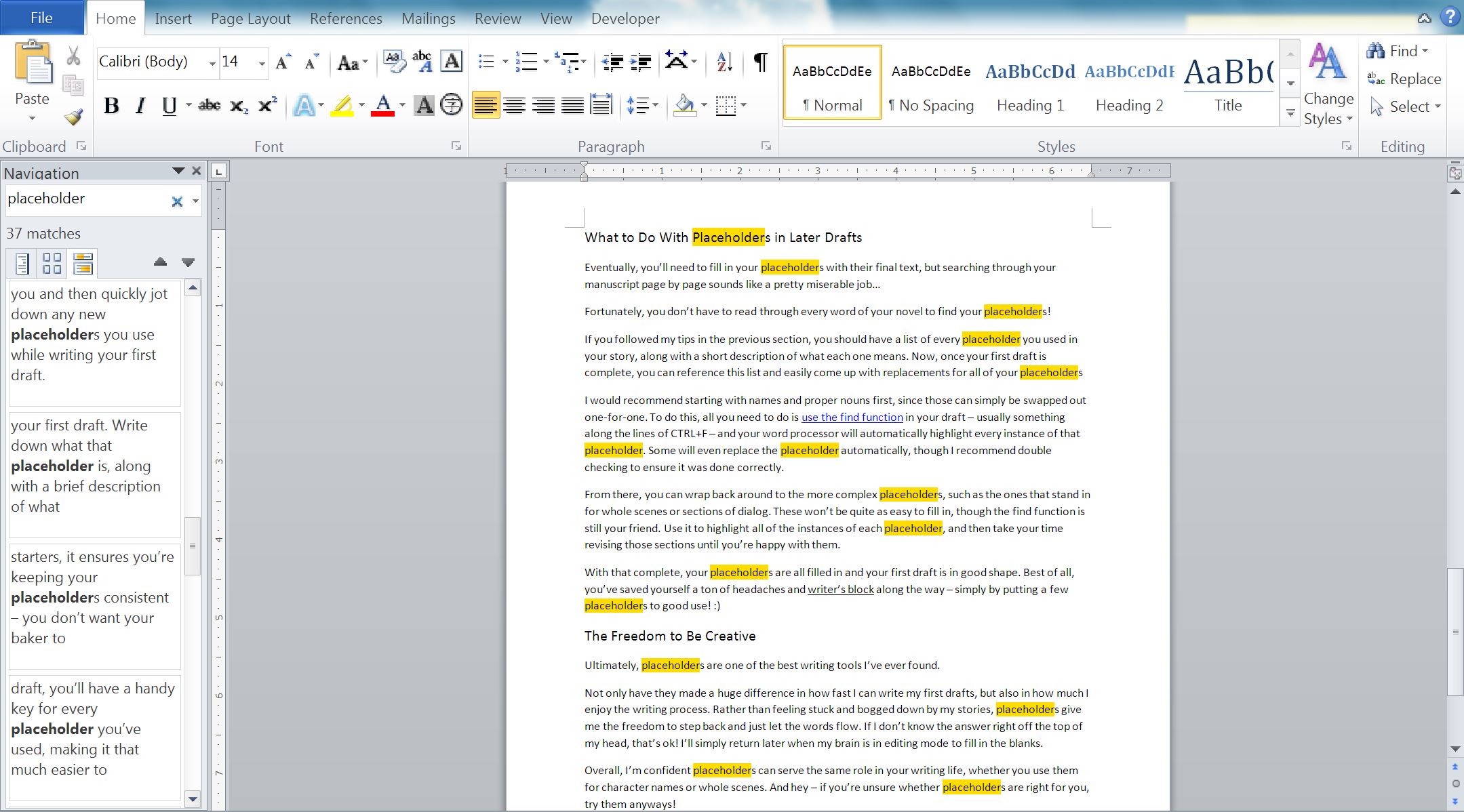
To do this, all you need to do is use the find function in your draft—usually something along the lines of CTRL+F—and your word processor will automatically highlight every instance of that placeholder. Some will even replace the placeholder automatically, though I recommend double checking to ensure it was done correctly.
Dialog, Scenes, and Prose:
From there, you can wrap back around to the more complex placeholders.
These placeholders are the ones that stand in for scenes or sections of dialog, and as a result they won’t be quite as easy to fill in—though the find function is still your friend. Use it to highlight all the instances of each placeholder, and then take your time revising those sections until you’re happy with them.
With that complete, your placeholders are filled in and your first draft is in good shape. Best of all, you’ve saved yourself a ton of headaches and writer’s block along the way—simply by putting a few placeholders to good use! 🙂
The Freedom to Be Creative
Ultimately, placeholders are one of the best writing tools I’ve ever found.
Not only have they made a huge difference in how fast I can write my first drafts, but also in how much I enjoy the writing process. Rather than feeling stuck and bogged down by my stories, placeholders give me the freedom to step back and just let the words flow. If I don’t know the answer right off the top of my head, that’s ok! I’ll simply return to it later when my brain is in editing mode to fill in the blanks.

Overall, I’m confident placeholders can serve the same role in your writing life, whether you use them for character names or whole scenes. And hey—if you’re unsure whether placeholders are right for you, try them anyway!
You can always CTRL+F them away if they don’t work for you. 😉
[thrive_leads id=’9779′]